

Water is no longer the only question.
Rainfall can reduce the need for irrigation, but it also changes the conditions in which other work takes place. Wetter soil, surrounding vegetation and the timing of field operations all require attention.
What looks like a quieter part of the year can involve a different set of decisions.
What the Change of Season Reveals
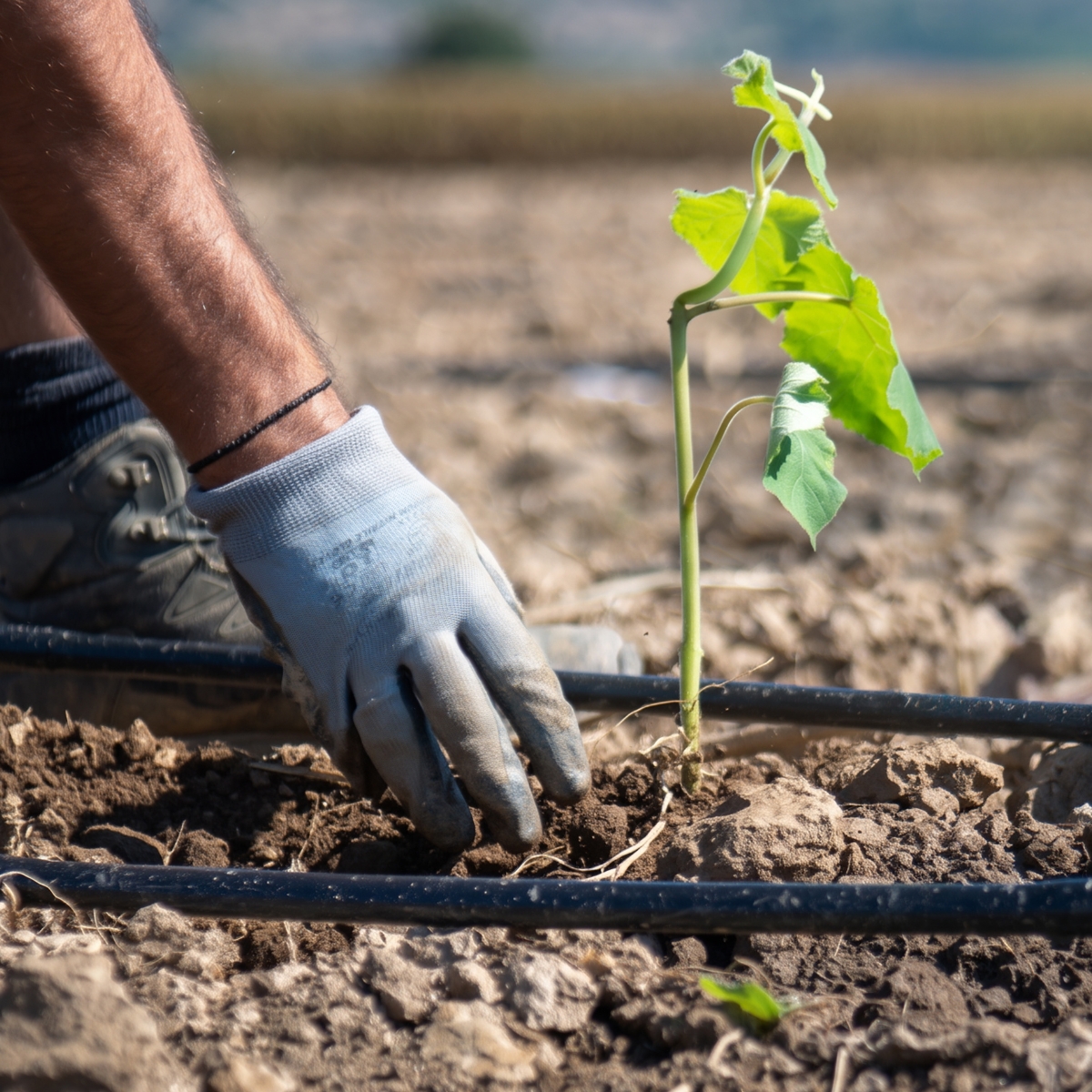
As the season turns, it is a good moment to look closely at how young trees are settling in.
Are the trees establishing successfully? Is surrounding vegetation affecting their access to water and nutrients? Are there areas that need further attention?
FAO guidance recommends checking tree establishment in the months after planting, with the timing adapted to local climate and plantation conditions.
The purpose is to understand the condition of the plantation before deciding what to do.
Why Wet Ground Changes the Work
Wet soil changes what can be done on a site, not only what needs doing.
Research collected by the European Commission Joint Research Centre shows that soil moisture has a dominant influence on how easily soil is compacted. Compaction is most severe when heavy machinery works on wet ground, because the soil is softer and loses more volume under the same pressure. In very wet soil the visible damage can be slight while the large pores that carry water and air through the soil are destroyed.
FAO applies the same logic as a working rule for planted forests, advising against mechanical site preparation when the soil is already holding as much water as it can.
The effect outlasts the day of the work. Compacted soil takes in less water and sheds more of it as runoff, and compaction deeper in the soil is persistent, which is why it is treated as something to prevent rather than repair.
Some work therefore waits for the ground to be ready.
Why Bare Ground Is Not the Goal
A plantation with clean rows and nothing growing between them looks well kept. It is not what the guidance recommends, and the reason lies in the soil.
FAO advises against the complete removal of ground cover vegetation, because it increases soil erosion and nutrient loss. Where the slope is 15 percent or more, it recommends planting lines that follow the contour.
Research by the Joint Research Centre on erosion in European forest land, including a detailed case study in Italy, describes the mechanism. Where vegetation cover is temporarily absent, soil is exposed directly to the impact of rainfall and more of it moves down the slope. In Mediterranean conditions, where rain often arrives in intense bursts and falls on sloping ground, that exposure matters.
Cover and roots hold soil in place during the months when water is moving across it.
What Returns With the Water
Rain reaches everything growing on a site, not only the trees that were planted.
According to FAO, dense weed growth slows planted seedlings and can hold back or threaten young trees, through competition for moisture, nutrients and light, and controlling it is what allows newly established trees to survive and grow.
That sits alongside the previous point rather than against it. The same guidance advises against complete weed removal during tending, so the question on any site is how much to control and where, rather than whether to clear everything.
The same guidance makes a wider point: planting is only the start. What happens in the months that follow, season by season, shapes how well young trees settle into their new ground.
A plantation in late autumn is not waiting for spring. If you would like to understand how ProspecTree organises this work, our Contract Information Pack explains how Professional Management connects to the Lease of Use and the Contractual Terms that apply. You can request it at info@prospectree.com.
Reference
FAO:
https://www.fao.org/sustainable-forest-management-toolbox/modules/management-of-planted-forests/en
European Soil Data Centre (ESDAC):
https://esdac.jrc.ec.europa.eu/themes/soil-compaction1


