What does planting actually ask of a tree? Its appearance alone will not tell you.
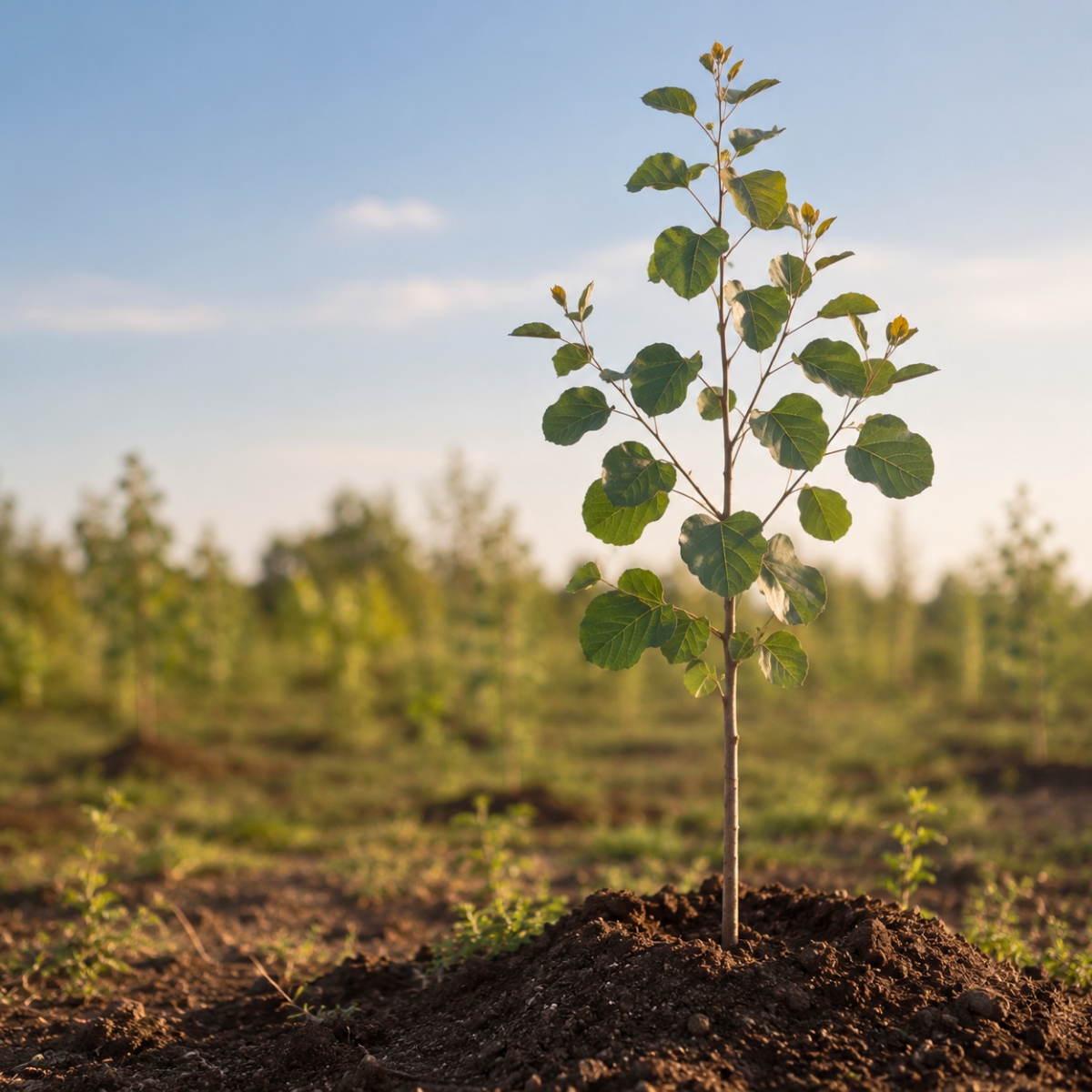
A young tree goes into prepared ground. Weeks can pass, and it is still there, still green and almost exactly the same height. It would be easy to assume that something has gone wrong.
What Planting Means for a Young Tree
Planting moves a young tree into an entirely new environment. Light, temperature, wind exposure, soil structure and available moisture all change at once. The tree also has to build close contact between its roots and the surrounding soil. That contact matters because it allows the roots to take up water and nutrients.
At this stage, growing taller is not the priority. Establishing a root system in the surrounding soil is.
New root growth and better contact with the soil give the tree access to water and nutrients and make it physically more stable. FAO guidance on plantation establishment gives particular weight to rooting conditions for this reason.
The tree is therefore not simply settling in. It is adapting to conditions it has never experienced.
None of this is visible in a photograph. Height and canopy are easy to see and measure, which is why they tend to become the focus, but they show only part of what establishment involves.
Why Young Trees Remain Vulnerable After Planting
A common assumption is that once a tree is in the ground, the risk is over. In practice, young trees are particularly sensitive to water stress in the first months, while their roots are still establishing contact with the soil.
Roots can only absorb water from the soil they reach, and immediately after planting that area is small. Until the root system develops and reaches deeper soil, the tree depends on a steady and adequate supply of water.
FAO guidance on plantation establishment treats site conditions, rooting conditions and soil moisture as central to successful planting. Practice material from the EU CAP Network reaches a similar conclusion: site preparation affects root formation and survival, and controlling surrounding vegetation helps conserve the moisture young trees depend on.
For the same reason, there is no universal irrigation schedule. Water needs depend on weather, soil, species and planting material, and care has to respond to actual conditions rather than follow a calendar.
Why Visible Stillness Does Not Tell the Whole Story
A tree that has gained no visible height may have spent those weeks developing roots and adjusting to its new surroundings. Once it is better established, shoot and leaf growth can become more noticeable.
There is no fixed timetable for any of this. The pace varies with species, planting material, soil, moisture and weather, and it differs from tree to tree and from site to site. That variability is normal, and it is one reason responsible cultivation avoids imposing a simple “fast growth” narrative on a biological process.
The Quiet Months Still Require Attention
A young tree that looks quiet above ground does not need less attention. That is why care does not stop on planting day. Ongoing care, water management and protection throughout the establishment phase are central to how ProspecTree approaches tree cultivation.
Planting is only the beginning. If you would like to understand how that care is organised in practice, our Contract Information Pack sets it out in full. You can request it at info@prospectree.com. It explains how Professional Management connects to the Lease of Use and the Contractual Terms that apply.
Reference
FAO: https://www.fao.org/4/t0122e/t0122e07.htm
EU CAP Network:
https://eu-cap-network.ec.europa.eu/projects/practice-abstracts/forest-regeneration-practices-importance-planting-site_en